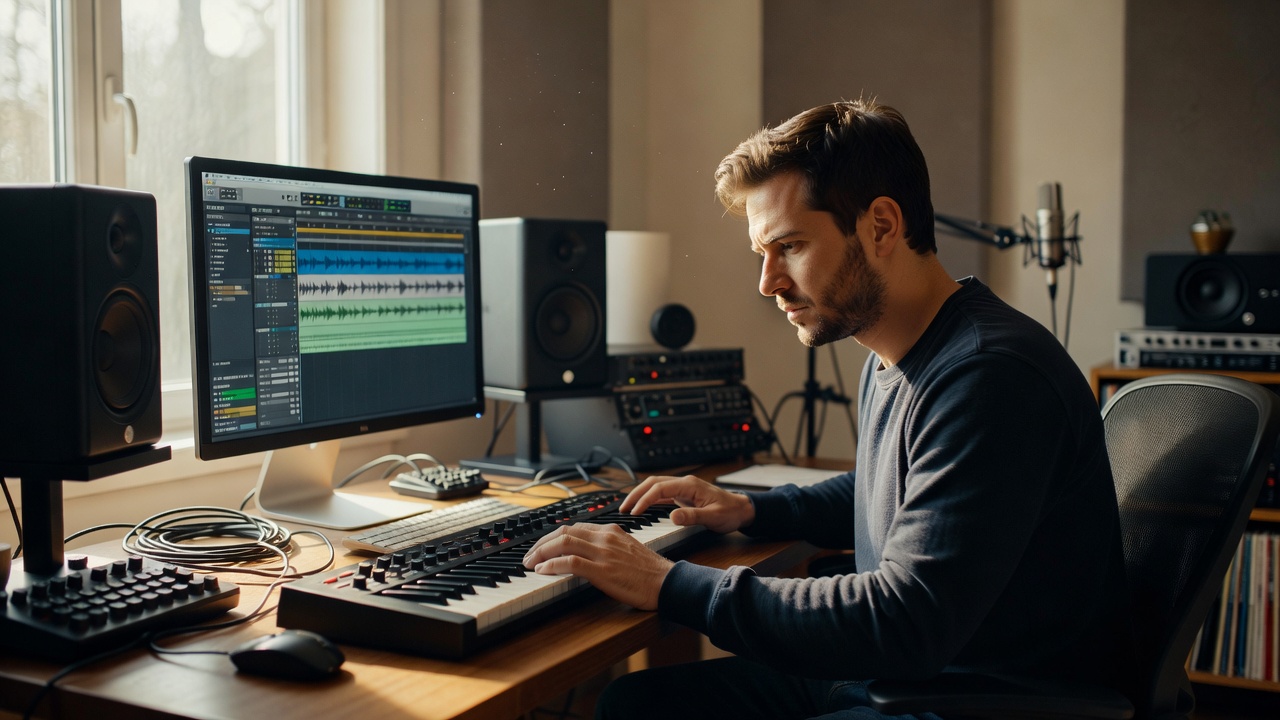
Choose a source with a clear gesture
Begin with audio you have permission to use. A short self-recorded phrase works well: tap a surface, play a few notes or record a nonverbal sound without background music. Keep an untouched original. Editing a duplicate lets you make bold decisions without losing the source or confusing the session’s history.
Listen for four moments with different roles. One may announce the phrase, another may sustain it, a third may provide a rhythmic interruption and the last may sound like an ending. They do not need equal lengths. A useful collection of slices offers contrast rather than four versions of the same attack.
Compare transient cuts with musical cuts
Automatic transient detection finds rapid changes in amplitude. It can create a helpful first pass, especially with drums, but it does not understand every musical gesture. A breath before a note, a soft consonant or the noisy lead-in to a chord may be part of what makes the source expressive.
Place a cut just before an attack, then move it slightly earlier and compare. Does the added lead-in create anticipation, or merely delay the useful sound? Next, trim the end. The right boundary depends on the new phrase you are making, not only on where the original performer paused.
A visual chop map · no audio playback
Original order: A–B–C–D. Exercise order: A–C–pause–B. Save D for a later response.
Repair clicks without erasing character
An abrupt waveform discontinuity can create a click at an edit. Zoom in, inspect the boundary and audition a short fade. A zero crossing can be a useful location, but a visually neat crossing does not guarantee a seamless edit, particularly in stereo material where channels may cross at different times.
Use the smallest effective fade rather than applying a large one everywhere. Too much fade-in can blunt a drum attack; too much fade-out can remove a tail that carries the groove. Check edits at a sensible monitoring level, then listen in context. A repair that sounds perfect alone may soften the phrase too much.
Decide how slices should stop
In a sampler, one-shot playback commonly continues after the triggering note ends. Gated playback commonly follows note duration or an amplitude envelope, though exact behavior varies by instrument. Learn which mode your sampler uses before assuming the MIDI note length controls the sound’s length.
A choke group can stop one slice when another begins. This is useful when overlapping tails blur the rhythm, but it can also cut a sound too abruptly. Compare choke behavior with a short release envelope. Sometimes overlap supplies continuity; sometimes a clean stop makes the new pattern legible.
Change pitch and time intentionally
Traditional resampling links playback speed, pitch and duration: slower playback lowers pitch and lengthens the sound. Time-stretching attempts to alter duration while preserving pitch, or separates the controls in other ways. Different algorithms handle sustained tones, percussion and complex mixtures differently.
Choose the process by the musical result. A rough artifact may support the texture, while a clean algorithm may preserve a delicate attack. Neither is automatically more creative. Compare at matched levels and listen for damage to the part of the sample you actually wanted to keep.
Build a phrase that did not exist before
Map four slices to adjacent pads or keys. Play A, then C, leave a gap and answer with B. Record several passes without looking for a perfect take. Listen back and choose the version with the clearest phrase, even if one hit needs a small timing correction.
Duplicate the phrase and use D only at the end of the second repetition. That small reservation gives D a reason to exist. Try shortening C in one version and lengthening the silence in another. Save both versions so you can compare decisions rather than relying on memory.
Check continuity and source responsibility
Bring the drum pattern back in. If a slice’s attack doubles the snare too heavily, move one event, shorten the slice or choose a different accent. If the gap feels accidental, make it more deliberate or let a quiet tail bridge it. The goal is a convincing relationship, not an impressive number of cuts.
Finally, preserve your source notes when you export or move the project. Reordering a phrase can transform its musical function, but it does not automatically remove rights in the original recording or composition. Keep permission questions visible while the creative work develops.
Studio word: envelope
A control shape that changes a parameter over time. An amplitude envelope can shape a slice’s attack, sustain and release; exact stages and behavior depend on the sampler.